Tribute to "The Legend" — Athena Trace 2026 Writeup
A quote, a service record, and a record-breaking climb identify the man in minutes. The challenge is realising which of his summits the question is actually asking about.
Content note
This challenge concerns the final expedition of mountaineer Nirmal “Nimsdai” Purja, who was killed in the Broad Peak avalanche of 30 July 2026 along with nine other climbers.
The challenge is presented as a tribute, and this writeup follows that intent. It documents the OSINT methodology used to reach the answer, and does not treat the circumstances of the accident as part of the game.
The challenge
“Giving Up is not in the blood sir.” He went from the Gurkhas, to the Special Boat Service, to fourteen summits in six months. He was going round for a third time. Identify this man, then tell us the highest altitude he reached and where he was standing when he reached it.
Flag format:
trace{elevation,lat,lon}— elevation in metres to exactly 2 decimal places, no thousands separator; then latitude and longitude in decimal degrees to exactly 6 decimal places. Comma separated, no spaces.
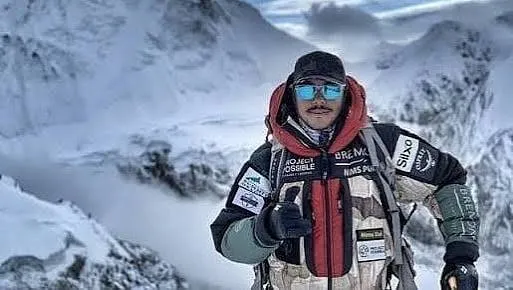
The attached photo. The sponsor patches alone would identify him — but the quote is faster.
Step 1 — The quote
The most distinctive string in the prompt is the quote itself:
"Giving up is not in the blood sir"It’s a documented line associated with Nirmal “Nimsdai” Purja, used in his own public material around the 14 Peaks film. A single exact-phrase search resolves the identification.
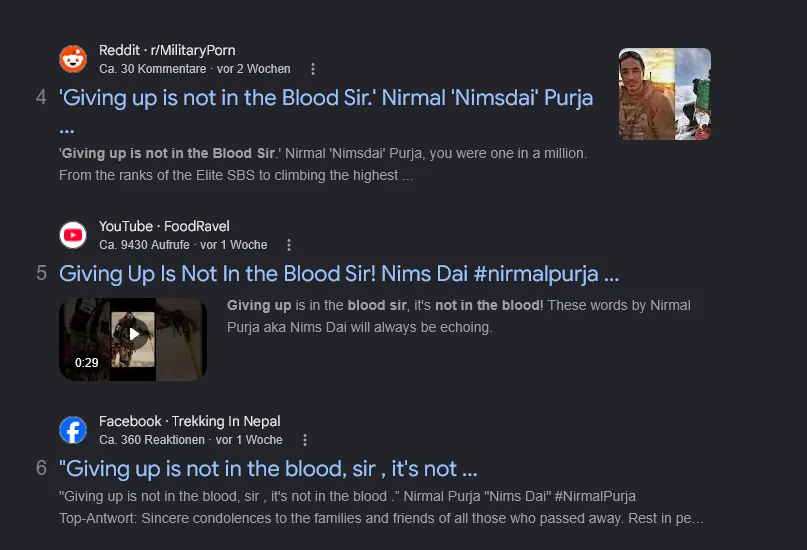
One query, three platforms, one name. Exact-phrase quotes rarely need a second search.
Step 2 — Confirm against the biography
The remaining clues all check out against the same person, which is what turns a lead into an identification:
- Brigade of Gurkhas — his initial military service.
- Special Boat Service — he went on to serve in the SBS.
- Fourteen summits in six months — in 2019 he climbed all fourteen eight-thousanders in six months and six days, the Project Possible record.
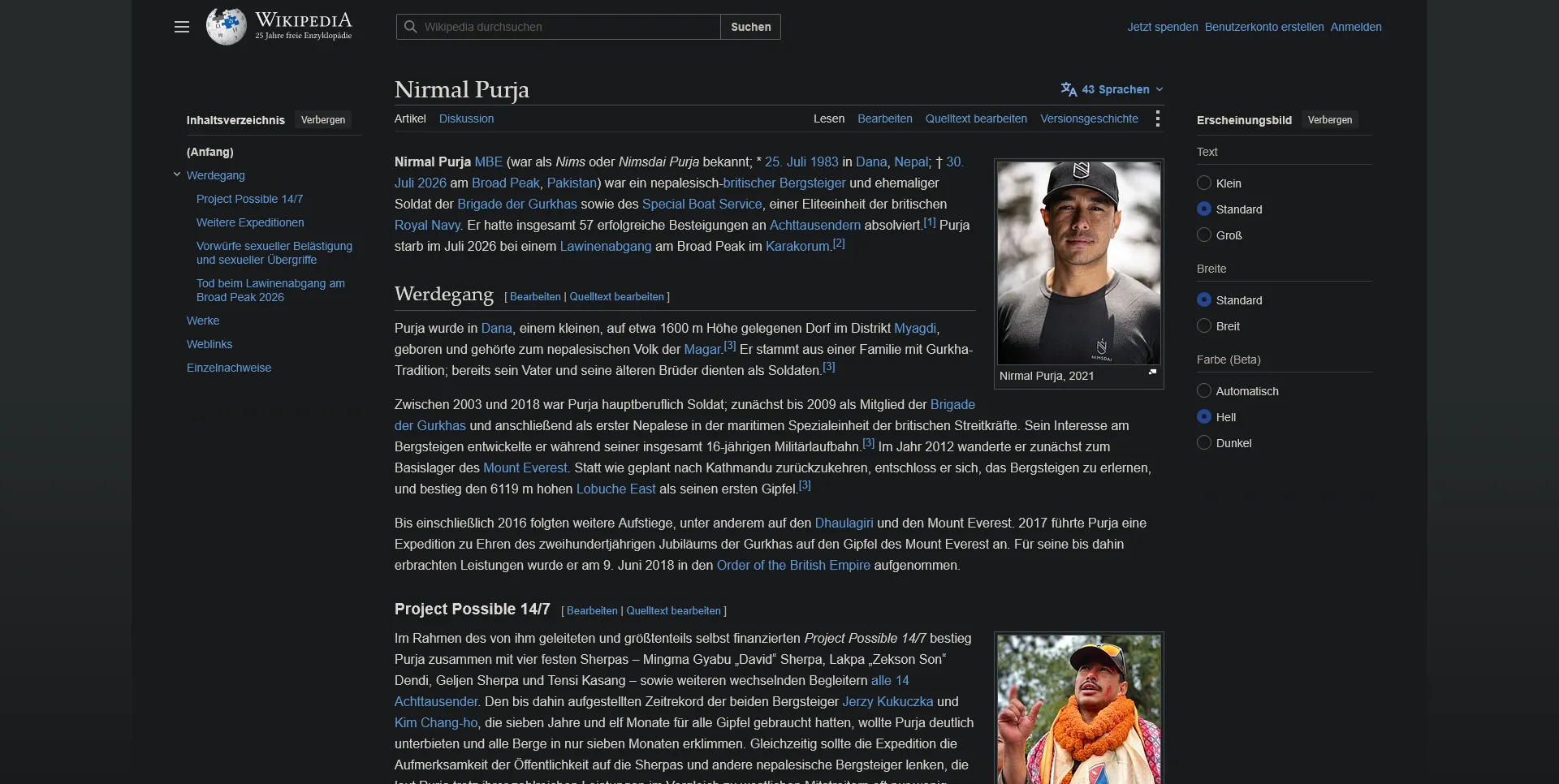
Gurkhas, SBS, 14 peaks — every clue from the prompt sits in the first paragraph of the biography.
Three independent biographical facts converging on one individual is a clean confirmation. No ambiguity remains at this point.
Step 3 — The clause that changes the question
“He was going round for a third time.”
This is where the challenge actually lives, and it’s easy to read past.
The naive answer to “the highest altitude he reached” is Everest — he summited it, and it is the highest point on Earth. But if that were the intended answer, the third-time clause would be doing no work at all, and the flag would demand centimetre-precision coordinates for a summit that anyone can look up.
The clause is there to scope the question. Purja’s third round of the fourteen eight-thousanders — the Hat-Trick Challenge, documented on his own site — is the expedition the prompt is asking about. So the question is not “what is the highest he ever stood”, but “how high did he get on this attempt, and where”.
Lesson: when a prompt includes a clause that would be redundant under your current reading, your reading is probably wrong. Redundant-looking detail in a tightly written challenge is usually a scoping constraint.
Step 4 — Locating the expedition
Searching for the third round narrows to the Broad Peak expedition of July 2026. His own Instagram documents the decision: the plan was G2, then he added Broad Peak mid-expedition.
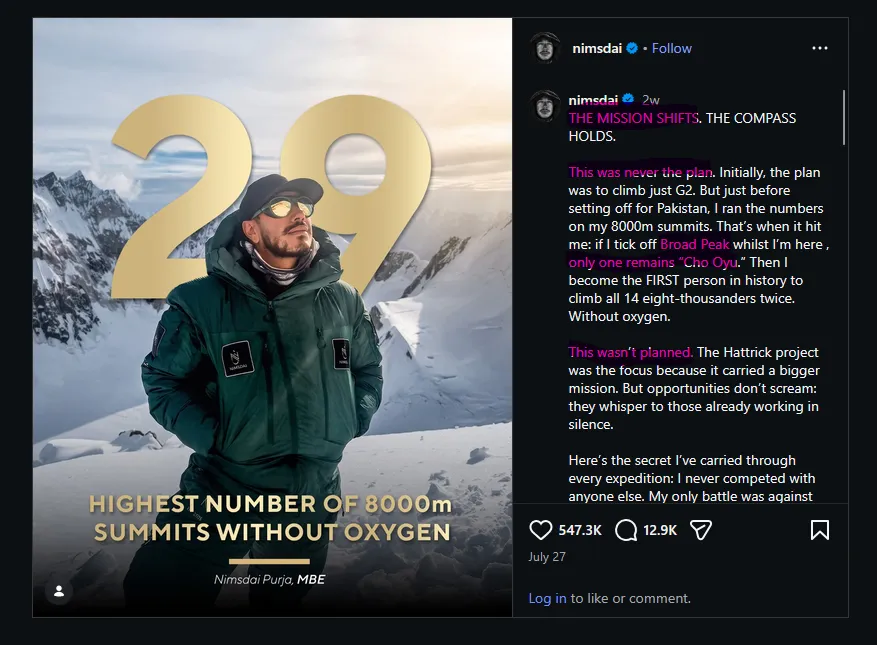
Posted July 27 — three days before the tracker record below. Primary source for both the Hat-Trick reading and the mountain.
Reporting on the expedition — including coverage in Everest Chronicle — drew on publicly shared satellite tracker data to describe the party’s position on the mountain, above Camp II.
That reporting cites a rounded figure of 6,659 m. The flag format, however, asks for two decimal places on elevation and six on the coordinates. Rounded press figures won’t satisfy it, which is a strong hint about the intended source: the numbers must come from somewhere that publishes them at that precision natively.
Step 5 — The tracker record
The precision requirement points to the Garmin inReach satellite tracker output, which reports elevation to two decimals and coordinates to six by default. Screenshots of the publicly shared tracking record were widely redistributed during the search effort and remain indexed.
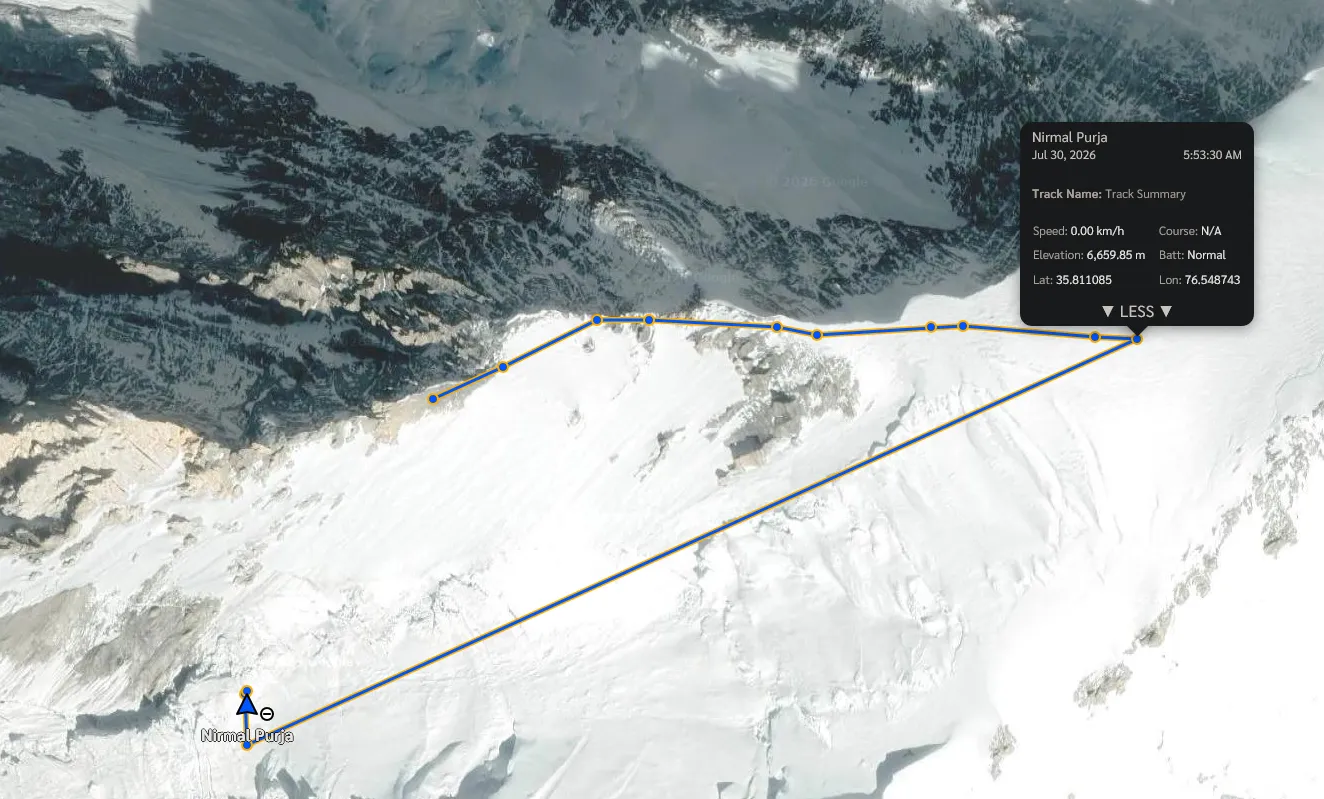
The final track point, timestamped 5:53:30 AM on July 30. Every value the flag asks for, at exactly the precision it asks for.
The relevant fields:
Elevation: 6,659.85 m
Lat:       35.811085
Lon:       76.548743
No conversion, no rounding, no map-pin estimation. The values arrive in exactly the format the flag asks for — which is the setter’s way of telling you that you have found the right source rather than approximating from a secondary one. The same coordinates are cited as the incident position in documentation of the accident.
Note the thousands separator in the raw output: the format specification says no
thousands separator, so 6,659.85 becomes 6659.85.
Result
The tracker data provides the exact values required by the challenge:
trace{6659.85,35.811085,76.548743}These coordinates correspond to a real fatal accident, so I have kept the conclusion deliberately factual.
Methodology notes
The chain in full:
quote → Nimsdai Purja → Gurkhas / SBS / 14-peaks confirmation → “third time” = Hat-Trick Challenge → Broad Peak expedition → inReach tracker record → exact values
Three things carried the solve:
- An exact-phrase search on the most distinctive string. Quotes are among the highest-signal artifacts in an OSINT prompt — they are unique, indexed, and usually attributable in one query.
- Multi-fact confirmation before proceeding. Gurkhas, SBS, and the 2019 record independently point to the same person. Identification should rest on convergence, not on a single striking detail.
- Treating the flag format as a source hint. Two decimals of elevation and six of latitude is not an arbitrary demand — it describes the output of a specific class of device. Reading the format told us which source to look for before we found it.
Sources
- Nirmal Purja — Wikipedia — biography: Brigade of Gurkhas, Special Boat Service, the 2019 Project Possible record, and his death on Broad Peak on 30 July 2026
- Nirmal Purja on X, 6 Dec 2021 — the “Giving up is not in the blood, Sir” quote in his own words, posted around the 14 Peaks release
- Nimsdai — Hat-Trick Challenge — his own site documenting the third round of the 14 eight-thousanders; the “going round for a third time” clue
- Everest Chronicle, 31 Jul 2026 — tracker data showing Nimsdai at 6,659 m above Camp II, then a descent consistent with the avalanche
- @nimsdai on Instagram, 27 Jul 2026 — “THE MISSION SHIFTS. THE COMPASS HOLDS.” — the mid-expedition switch from G2 to Broad Peak, his last post
- Garmin MapShare — Nimsdai’s tracker — the publicly shared inReach tracking page the record comes from; elevation and coordinates at exactly the precision the flag demands
- Challenge: Athena Trace 2026 — “Tribute to The Legend”
Nirmal Purja died on Broad Peak on 30 July 2026, together with nine others on his team.