Cycle Support — Athena Trace 2026 Writeup
A patent drawing sold as wall art, cropped just above the one field you need. The answer is a database lookup keyed on the fields that survived.
The challenge
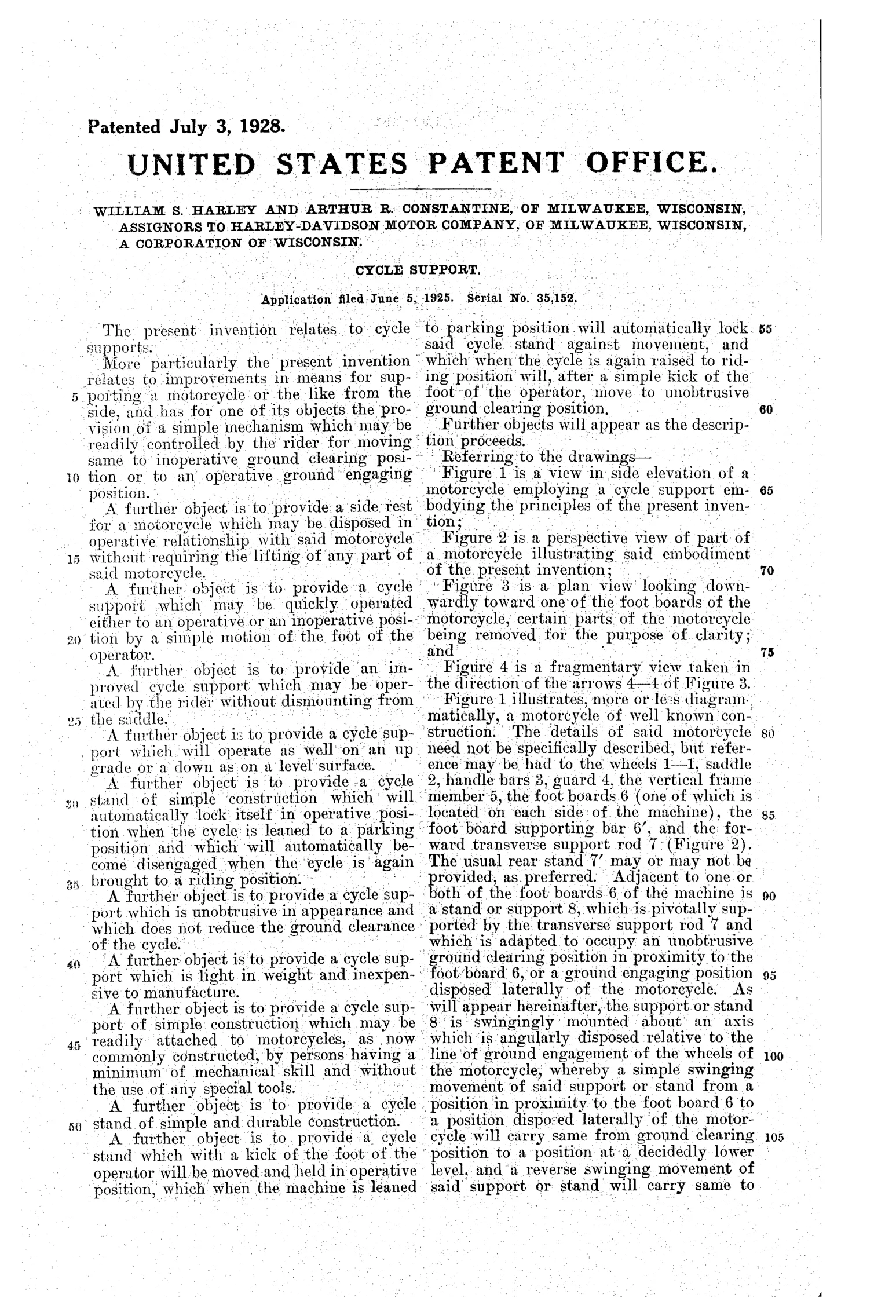
Somebody sells this page as wall art. It gives you the inventors, the company, the filing date and the serial number — everything except the number the patent was actually granted under. Find that number.
Flag format:
trace{1234567}
Reading the sheet
Everything on the page that isn’t a drawing is a search key. Transcribing the header block:
| Field | Value |
|---|---|
| Patented | July 3, 1928 |
| Inventors | William S. Harley, Arthur R. Constantine |
| Assignee | Harley-Davidson Motor Company |
| Title | Cycle Support |
| Application filed | June 5, 1925 |
| Serial No. | 35,152 |
Six fields, and the one thing missing is exactly the thing being asked for.
That absence isn’t tampering. Patent drawings are a staple of the decorative print market, and sellers routinely crop or clean the top of the sheet because the grant number sits in a header band that clutters the composition. The setter didn’t doctor anything — they took an off-the-shelf poster. Which is what makes the challenge realistic: this is the state you actually find these images in.
The shape of the problem
This isn’t identification. There’s nothing to recognise — the sheet tells you what it is in plain type. It’s a reverse database lookup: you have six attributes of a record and need a seventh, and the record is in a public, fully indexed database.
The only real skill is choosing which fields to key on.
Not all six are equally useful:
Cycle Support— weak. Generic phrasing, and patent titles of this era are deliberately bland. Many records share it.Harley-Davidson Motor Company— weak on its own. The company holds hundreds of patents.July 3, 1928— weak alone. Hundreds of US patents issued on any given Tuesday in 1928.William S. Harley+Arthur R. Constantine— strong. A specific two-inventor pairing.35,152— strongest. A serial number is a unique key within its series.
So the query is built from the distinctive fields, not the descriptive ones:
"William S. Harley" "Arthur R. Constantine" "Cycle Support" "35,152"General principle: when searching a structured record, rank your fields by selectivity before you type. Identifiers beat names, names beat dates, dates beat titles. Leading with the title is how you end up paging through results.
The lookup
Google Patents returns US1675551A — Cycle support, and every field lines up:
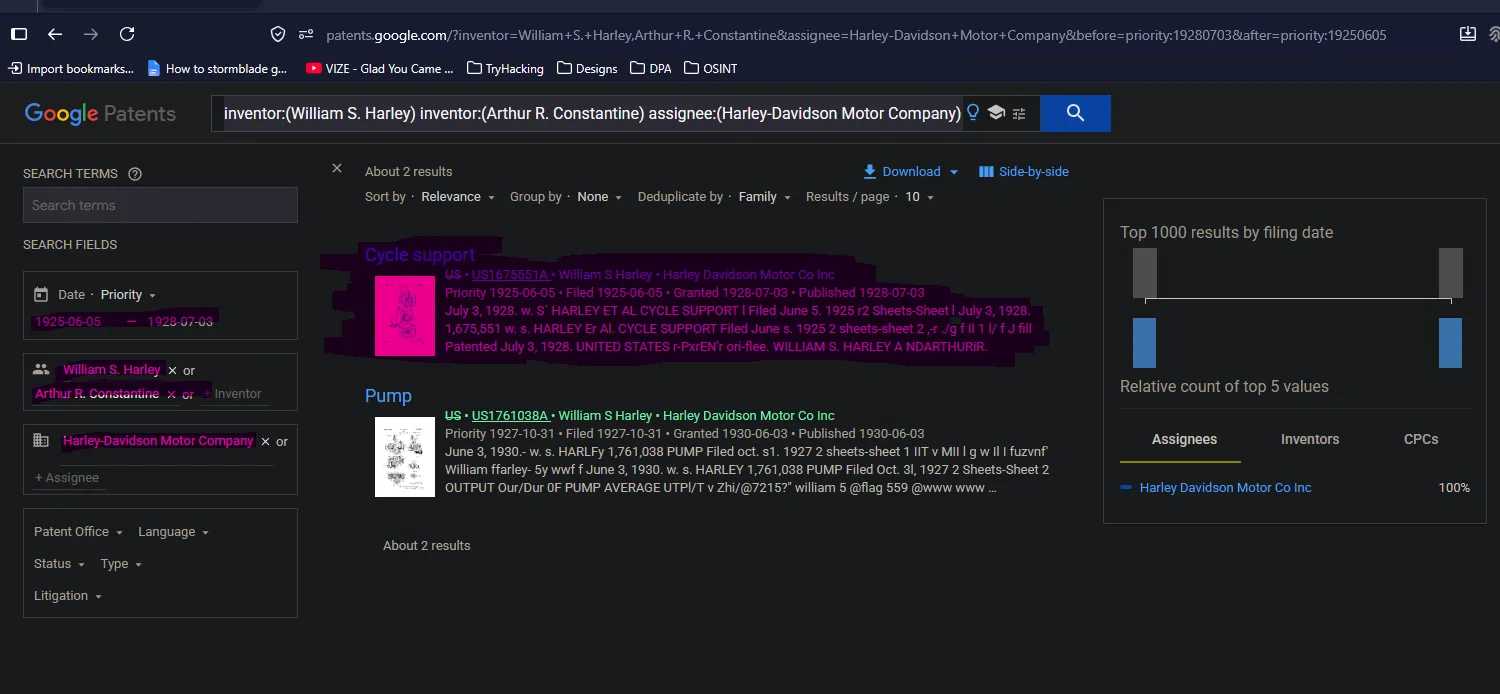
Keyed on the inventor pair and assignee, the whole database collapses to two records — and only one of them is a cycle support.
| Field | Sheet | Record |
|---|---|---|
| Inventors | William S. Harley, Arthur R. Constantine | ✅ same |
| Assignee | Harley-Davidson Motor Company | ✅ Harley Davidson Motor Co |
| Filed | June 5, 1925 | ✅ 1925-06-05 |
| Granted | July 3, 1928 | ✅ 1928-07-03 |
| Title | Cycle Support | ✅ Cycle support |
The confirmation that actually matters
Four matching fields is good. The fifth is what makes it certain:
The record’s application number is US35152A — and the sheet’s Serial No. is
35,152. Those are the same number in two notations. The serial number is the
application number; the sheet writes it with a thousands separator, the database
writes it without and wraps it in country and kind codes.
That’s a different quality of evidence from the other matches. Names, dates, and assignees could in principle coincide across related filings — a company filing several similar applications on the same day with the same inventor pair is entirely plausible. A matching serial number cannot coincide. It’s a unique key, so the match is identity, not similarity.
Worth internalising as a habit: when verifying a record match, find the field that is a unique identifier and check that one. Corroborating five descriptive fields is weaker than confirming one key.
Extracting the number
US1675551A decomposes as:
US— country code1675551— the patent numberA— kind code (for US patents of this era, the granted specification)
Strip the codes and you have 1675551, conventionally written 1,675,551.
The flag spec settles the formatting: the example trace{1234567} shows seven
digits, no separator. So the comma comes out.
Flag
trace{1675551}Takeaways
- Missing data is often a production artifact, not a riddle. The grant number is absent because a print seller cropped the header. Recognising why something is missing tells you whether to look for it elsewhere or reconstruct it — here, elsewhere.
- Rank fields by selectivity before searching. Serial numbers and unusual name pairs are keys; titles and company names are filters. Query with the keys.
- Verify on a unique identifier, not on a pile of descriptive matches. The serial-to-application-number equivalence turned a strong resemblance into a certainty.
- Know the notation of the database you’re querying.
US1675551Aisn’t the patent number — it’s the number wrapped in country and kind codes. Knowing which characters carry meaning is the difference between a right and a wrong submission. - Historic patents are exceptionally well indexed. Full-text, structured, and free. For anything pre-war and American, the record almost certainly exists and is searchable on every field printed on the sheet.
Sources
- US Patent 1,675,551 — Cycle support — the record itself: Harley & Constantine, Harley-Davidson Motor Company, filed 1925-06-05, granted 1928-07-03, application number US35152A
- Google Patents — the database the lookup runs against; free, full-text, indexed on every field the sheet gives you
- Challenge: Athena Trace 2026 — “Cycle Support”
Image credits
Challenge artifact: drawing sheet from US Patent 1,675,551 (“Cycle Support”, W. S. Harley and A. R. Constantine, assigned to Harley-Davidson Motor Company, granted 3 July 1928). United States patent documents of this period are in the public domain.