House Hunting — Athena Trace 2026 Writeup
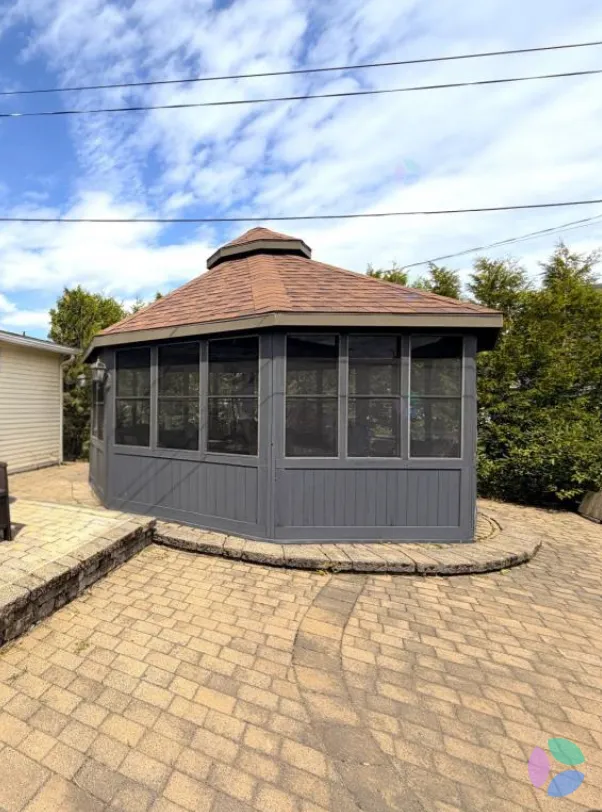
A screened gazebo, no landmarks, no signage, no readable text. The whole challenge is knowing that the object is the index — and that the listing is the authority on spelling.
The challenge
This gazebo is for sale. So is everything around it. Give me the complete civic address.
Flag format:
trace{Number_Street_City}— underscores for spaces, street name exactly as the listing spells it, no comma after the number.
What you’re actually given
This is a deceptively bare artifact. Run through the usual geolocation checklist and almost everything comes back empty:
- No signage, no text, no plates. Nothing to read, nothing to translate.
- No landmark, no terrain, no skyline. A hedge and a neighbouring wall block every sightline.
- No distinctive infrastructure. Overhead power lines and concrete pavers, which narrow the world to “North America, probably” and stop there.
The vegetation (dense conifer hedge), the paver patio, the vinyl siding on the adjacent house, and the aerial power distribution all read as Canada or the northern US. That’s a continent, not an address.
So the environmental read is a dead end — and that is deliberate. The prompt is pointing somewhere else entirely.
The pivot: the object is the index
“This gazebo is for sale. So is everything around it.”
That sentence is the entire challenge. It tells you the gazebo is not a landmark to be located — it is an object photographed for a real estate listing. The photo isn’t a snapshot; it’s listing media. Which means it is already indexed, already public, and already attached to a civic address somewhere in a property database.
That reframes the task completely:
- Wrong approach: identify the location from environmental clues.
- Right approach: find the listing the photo belongs to.
This is a different kind of search. You’re not geolocating; you’re doing image provenance against commercial listing databases.
Step 1 — Reverse image search the listing media
Google Lens on the gazebo image is the tool that fits, because Lens does visual similarity against indexed web images rather than trying to geolocate content. Listing photos are heavily syndicated — the same images appear on the brokerage site, the national listing portal, and aggregators — so a listing photo has an unusually large indexed footprint compared to a private snapshot.
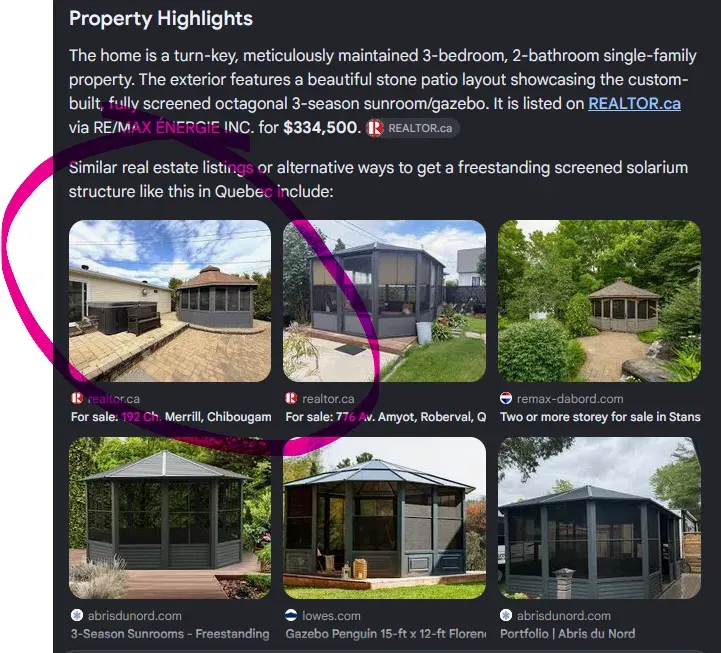
The search converges on the query shape “house for sale with a gazebo in Quebec”, and the visual-match strip returns the source directly: a REALTOR.ca listing, brokered by RE/MAX ÉNERGIE INC., priced at $334,500 — a turn-key 3-bedroom, 2-bathroom single-family property whose exterior features a stone paver patio and a custom-built, fully screened octagonal 3-season sunroom/gazebo.
That description matches the artifact point for point: octagonal, fully screened, custom-built, sitting on a paver patio.
Step 2 — Verify before submitting
A visual-similarity hit is a lead, not a confirmation. Gazebos of this type are
mass-market products — the same search returned near-identical structures from
abrisdunord.com and Lowe’s. Matching the gazebo model is not matching the
property. The verification has to come from the surroundings, which are unique
even though the gazebo isn’t.
Opening the listing gallery and comparing against the artifact:
| Feature | Artifact | Listing photo |
|---|---|---|
| Gazebo | Grey, octagonal, screened, shingled roof with cupola | Identical |
| Patio | Beige/tan concrete pavers, curved apron around gazebo | Identical |
| Retaining wall | Low stone-block wall stepping down from patio | Identical |
| Adjacent house | Beige horizontal siding, roof vents | Identical |
| Hedge | Dense conifer hedge behind gazebo | Identical |
| Hot tub | Not in artifact frame | Present in adjacent frame |
The artifact turns out to be a different frame from the same photo shoot as listing image 18/22 — same gazebo, same wall, same paver run, shot from a different angle. That’s confirmation, not resemblance.
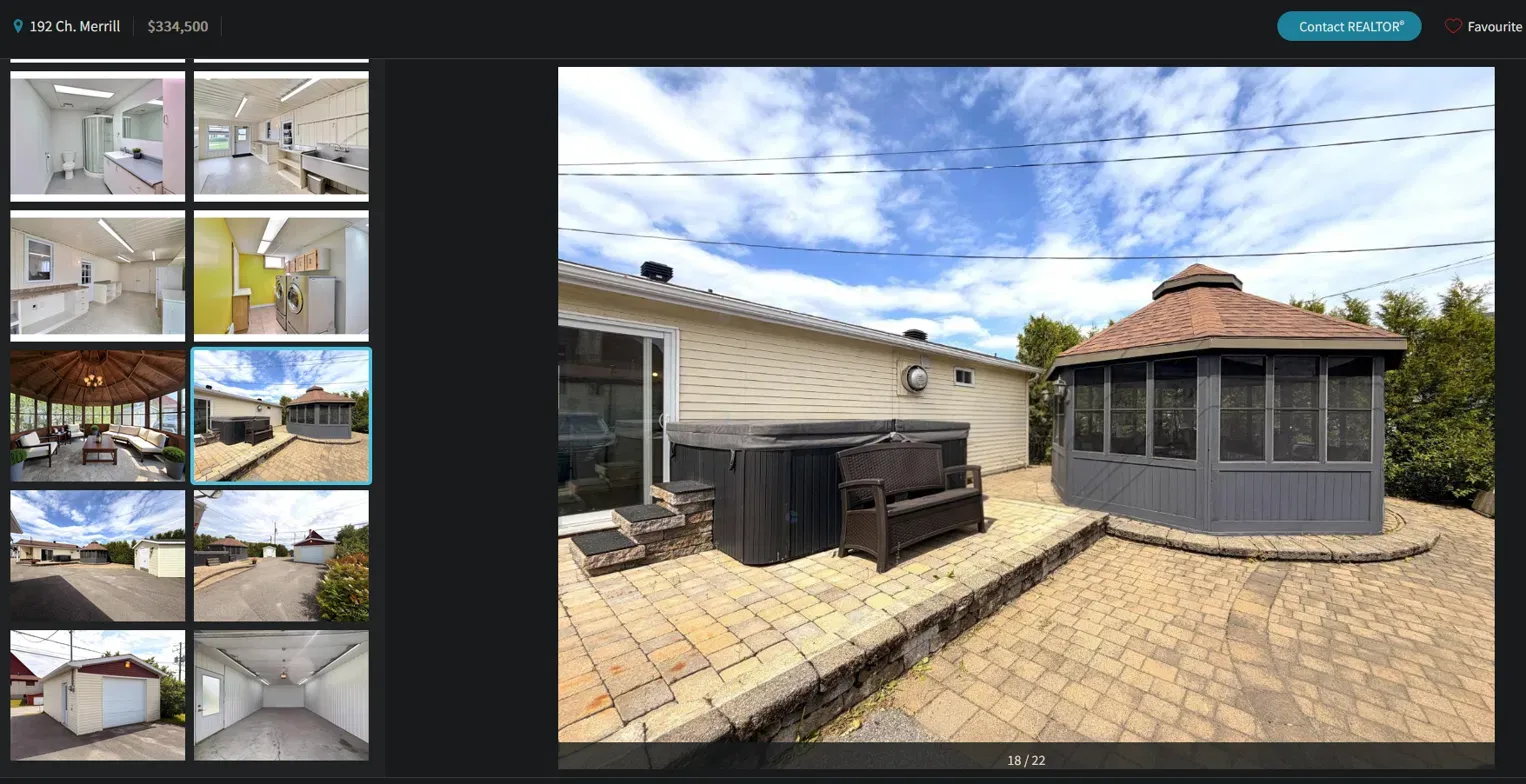
Address: 192 Chemin Merrill, Chibougamau, Québec.
Step 3 — The spelling clause
The flag format specifies: “street name exactly as the listing spells it.”
Worth pausing on, because this is where the challenge could bite. REALTOR.ca’s
listing header renders the address in abbreviated form — 192 Ch. Merrill — with
Ch. as the standard Québec abbreviation for Chemin. The full street name in
the listing is Chemin Merrill, and that is what the flag takes.
The lesson is narrower than it first looks: a portal header abbreviating a street type is a display convention, not an alternate spelling. “As the listing spells it” is there to fix things like Chemin vs Rue vs Boulevard and accented forms — not to make you transcribe a UI abbreviation.
Don’t over-fit to trap-hunting. On a board full of naming-convention traps it’s tempting to read every abbreviation as a deliberate snare. Sometimes the straightforward reading is the right one, and the spelling clause is just guarding against a genuinely ambiguous street type.
Flag
trace{192_Chemin_Merrill_Chibougamau}Takeaways
- Read the prompt for the search modality, not just the question. “This gazebo is for sale” tells you the artifact lives in a commercial database. That single word — sale — redirects you from geolocation to image provenance.
- A featureless photo is a signal. When the environmental clues are deliberately empty, the intended path is almost never environmental. Stop squeezing the hedge for information and ask what kind of photo this is.
- Listing media is over-indexed. Real estate photos are syndicated across brokerage, portal, and aggregator sites, which makes them far more findable by visual search than an ordinary personal photo.
- Verify on the non-reproducible features. The gazebo is a catalogue product and matches thousands of properties. The paver layout, retaining wall, and neighbouring siding are what actually pin this specific address.
- Chibougamau is not guessable. A remote town in northern Québec was never going to fall out of vegetation analysis. The database was always the route.
Sources
- REALTOR.ca — 192 Ch. Merrill, Chibougamau, QC (MLS 12886337) — the source listing the artifact belongs to; address and MLS number confirmed via the search index
- Google Lens — visual-similarity search that surfaced the listing from the gazebo frame
- Challenge: Athena Trace 2026 — “House Hunting”
Image credits
Challenge artifact: listing photograph of the property at 192 Chemin Merrill, Chibougamau, Québec, listed via RE/MAX ÉNERGIE INC. on REALTOR.ca. Reproduced here for the purpose of analysis and commentary; all rights remain with the rights holder.