Op Sindoor — Athena Trace 2026 Writeup
A single interior photograph, nine candidate sites, and a naming convention that decides whether a correct identification still scores.
Content note
This challenge concerns a real military operation in which people were killed, including civilians. The analysis below is deliberately narrow: it treats the photograph as an identification problem and nothing more. It takes no position on the legality, justification, or competing casualty claims surrounding the strikes, and it is not a commentary on the parties involved.
The challenge
Nine sites in one night. Two of them were the headquarters everyone already knew about; seven were not. Somebody was allowed in afterwards with a camera. Name the site, the city it sits outside, and the date it was struck.
Flag format:
trace{SiteName_City_YYYY-MM-DD}— underscores for spaces. Use the site name as the open-source damage assessments and the official briefings write it, not the form used in encyclopaedia article titles.
Reading the photograph first
Before any searching, the frame narrows the candidate set hard:
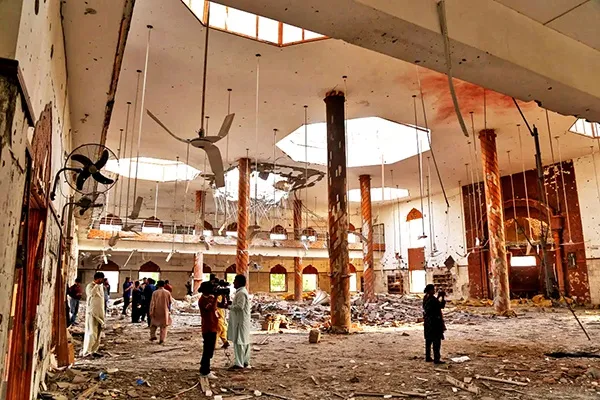
- This is a grand mosque, not a camp building. Patterned red-and-white columns, a two-storey arched gallery, a coffered ceiling with multiple domed apertures, ceiling fans on long drops. This is a purpose-built congregational hall with money spent on it.
- Multiple domes were breached — not one hole, several, in a line across the hall.
- Press are inside. Photographers and camera operators are standing in the rubble, working. Somebody organised access after the fact.
That last point is what the prompt is pointing at with “somebody was allowed in afterwards with a camera.” It is not a hint about which site — it is the reason an interior photograph of a struck site exists at all.
The candidate set
Operation Sindoor struck nine sites in the early hours of 7 May 2025 — four in Pakistan proper and five in Pakistan-administered Kashmir. The Indian briefing enumerated them:
| # | Site | Location |
|---|---|---|
| 1 | Markaz Subhan Allah | Bahawalpur, Punjab |
| 2 | Markaz Taiba | Muridke, Punjab |
| 3 | Sarjal / Tehra Kalan | Narowal, Punjab |
| 4 | Mehmoona Joya | Sialkot, Punjab |
| 5 | Markaz Ahle Hadith | Barnala, PoJK |
| 6 | Markaz Abbas | Kotli, PoJK |
| 7 | Maskar Raheel Shahid | Kotli district, PoJK |
| 8 | Shawai Nallah camp | Muzaffarabad, PoJK |
| 9 | Markaz Syedna Bilal | Muzaffarabad, PoJK |
The prompt’s “two of them were the headquarters everyone already knew about” refers to sites 1 and 2 — Bahawalpur and Muridke. Everything else was comparatively obscure before that night.
The architecture in the photograph does most of the filtering by itself. Sites 3 through 9 are camps, launch facilities, a repurposed health centre, and smaller neighbourhood mosques. None of them is a multi-dome congregational hall of this scale. The photo is one of the two big complexes.
Muridke or Bahawalpur — and the trap
This is where the challenge actually lives, and where I want to be honest about how it can go wrong.
Both large complexes had their mosques damaged. Both had journalists reach them. Both sit on the edge of their respective towns rather than in the centre. Several of the prompt’s clues — “allowed in with a camera”, “the city it sits outside” — feel like they discriminate between the two, and they do not. They narrow the field to the two headquarters and stop there.
The temptation is to reason your way to an answer from those clues. That is the trap. The photograph is the evidence; the prose is context. The correct move is to reverse-image search the file itself and read the wire caption. This is a distributed press photograph with an agency caption attached, and the caption names the site outright.
Doing that resolves it: the hall is the mosque at the Markaz Subhan Allah complex in Bahawalpur — the Jaish-e-Mohammed operational headquarters, also referred to as the Usman-o-Ali campus. Open-source damage assessment of the satellite imagery independently corroborates the interior: analysts noted that three domes of a large mosque were breached at the Bahawalpur site, with surrounding structures across roughly 2,100 m² destroyed. That matches the several blown-open dome apertures visible in the ceiling.
Lesson: when a challenge hands you an image, the image outranks your inference chain. Clue-reading feels like analysis, but it is reasoning around the evidence rather than from it. Search the artifact first.
The naming trap
The flag format is explicit: “as the open-source damage assessments and the official briefings write it, not the form used in encyclopaedia article titles.”
For this site the competing forms are:
- Encyclopaedia / long form: Jamia Masjid Subhan Allah — the mosque’s full name, as used in reference articles and some reporting.
- Briefing / damage-assessment form: Markaz Subhan Allah — the form used in the Indian government briefing and consistently across OSINT damage assessments.
The flag wants Markaz Subhan Allah. Note also the spacing: Subhan Allah as two words, not the run-together Subhanallah that appears in some quotations of the briefing.
The same pattern applies across the target list, which is presumably why the setter phrased the rule generally — Markaz Taiba (briefing) vs Markaz-e-Taiba (encyclopaedia), Shawai Nallah vs Sawai Nala, and so on. Transliteration from Urdu has no single canonical Latin form, so the setter has to name an authority. Here the authority is the briefings and the damage assessments.
The date
The operation ran in the early hours of 7 May 2025 — the Indian briefing placed it between roughly 01:05 and 01:30 local time. All nine sites were struck in that window.
Date: 2025-05-07.
Flag
trace{Markaz_Subhan_Allah_Bahawalpur_2025-05-07}Takeaways
- Search the artifact before you reason about it. Every clue in the prompt was compatible with two different answers. The wire caption on the photograph was compatible with exactly one. Reverse image search first, infer second.
- Architecture is a filter. Recognising “expensive congregational mosque” versus “camp structure” eliminated seven of nine candidates before any searching.
- Naming authority is a real category. “As the official briefings write it” is not decoration — for transliterated names it is the entire difference between a scoring and a non-scoring submission.
- Corroborate across source types. The interior photograph and the satellite damage assessment describe the same thing from different angles: multiple breached domes on a large mosque. Agreement across independent source types is what turns an identification into a confident one.
Sources
- MEA — Operation Sindoor hub — the Indian government’s official page; nine camps targeted, links to the briefings
- Transcript of Special Briefing on Operation Sindoor, 7 May 2025 — Foreign Secretary Misri’s opening statement; the site-by-site enumeration was in the accompanying presentation
- ORF — “Operation Sindoor: Understanding Context and Consequences” — tabulates all nine sites incl. Markaz Subhan Allah, Bahawalpur, and the 01:05–01:30 strike window
- The Tribune, 9 May 2025 — satellite damage assessment: three domes of the large mosque hit, structures across 2,100 m² reduced to rubble
- Al Jazeera, 7 May 2025 — target-by-target rundown; also shows the competing transliterations in the wild (“Markaz Subhanallah”)
- Business Today, 7 May 2025 — the long-form name “Jamia Masjid Subhan Allah” and the complex’s role as JeM’s operational headquarters
- Dawn, 8 May 2025 — ground reporting from Bahawalpur and Muridke; authorities arranged media visits to the struck sites
- Challenge: Athena Trace 2026 — “Op Sindoor”
Image credits
Challenge artifact — original caption: “Members of the media film the inside of a building after it was hit by an Indian strike in Bahawalpur, Pakistan, May 7, 2025.”
Photo: REUTERS/Stringer. Reproduced here for the purpose of analysis and commentary; all rights remain with the rights holder.