One Photograph — Athena Trace 2026 Writeup
A caption that names the landmark instead of the venue, a statue that vanished into an overexposed sky, and a flag that wanted the newspapers' spelling rather than the historically correct one.
The challenge
One photograph. No caption, no metadata, no context. Where was it taken, and on what day?
Flag format:
trace{PlaceName_YYYY-MM-DD}— replace any space in the place name with an underscore.
A black-and-white photograph: a loose crowd of perhaps a hundred people standing on open lawn, a monumental arch visible at the frame edge, a domed canopy structure beyond. Nothing written, nothing embedded.
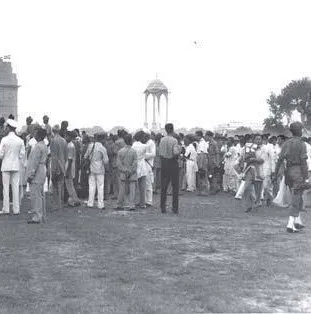
The entire starting material. The arch places it in seconds — everything that scores is in the small details.
This one cost me more attempts than it should have, and every wasted attempt came from a reasoning error rather than a research gap. The write-up is more useful as a record of those errors than as a solution path.
The scene
The arch is India Gate in New Delhi, which the architecture identifies immediately. Behind it sits the canopy — the cupola that until 1968 housed a marble statue of King George V.
So: New Delhi, some public gathering on the lawns by India Gate, some date in a window spanning most of a century.
Error 1 — Dating on the absence of an object
My first move was to date the photograph from the canopy. It looked empty. George V’s statue was removed in 1968, so an empty canopy meant the photo was taken after 1968. That eliminated everything earlier.
It was wrong, and it eliminated the correct answer.
The statue was pale marble, standing against a bright sky, in a low-resolution scan with a blown-out highlight range. It hadn’t been removed — it had dissolved into the white. The canopy wasn’t empty; the canopy was unreadable.
Lesson: never build a negative inference from a blown-out region of an image. Overexposure destroys light-coloured objects preferentially, so “there’s nothing there” in a burnt-out highlight means “I cannot see whether there’s anything there.” Absence of evidence in a clipped channel is not evidence of absence. Check the histogram before you reason about what a bright area does or doesn’t contain.
The error was worse than a lost step, because I used it to exclude the correct era. A false positive costs one attempt; a false exclusion closes the branch that contains the answer.
Error 2 — Treating a small detail as scenery
There was a second signal in my own crop that I noted and moved past: a flag on the upper edge of India Gate.
I logged it as background texture. It was the event.
A flag flying at a monument, with a crowd on the lawn below, in a photograph someone is asking you to date, is not decoration — it’s the reason the photograph exists. Had I taken it seriously, “flag hoisting” would have been the working hypothesis, and for India that puts 15 August 1947 at the top of the candidate list within seconds.
Lesson: in an undated photograph of a gathering, prioritise the small objects that imply purpose — flags, banners, poles, platforms, wreaths, uniforms — over the large objects that establish place. The architecture tells you where. The props tell you why, and “why” is usually what dates it.
Error 3 — Trusting a caption’s precision
Correcting course, I found the photograph republished by an official Indian government account, captioned as the first public flag hoisting at India Gate on 15 August 1947.
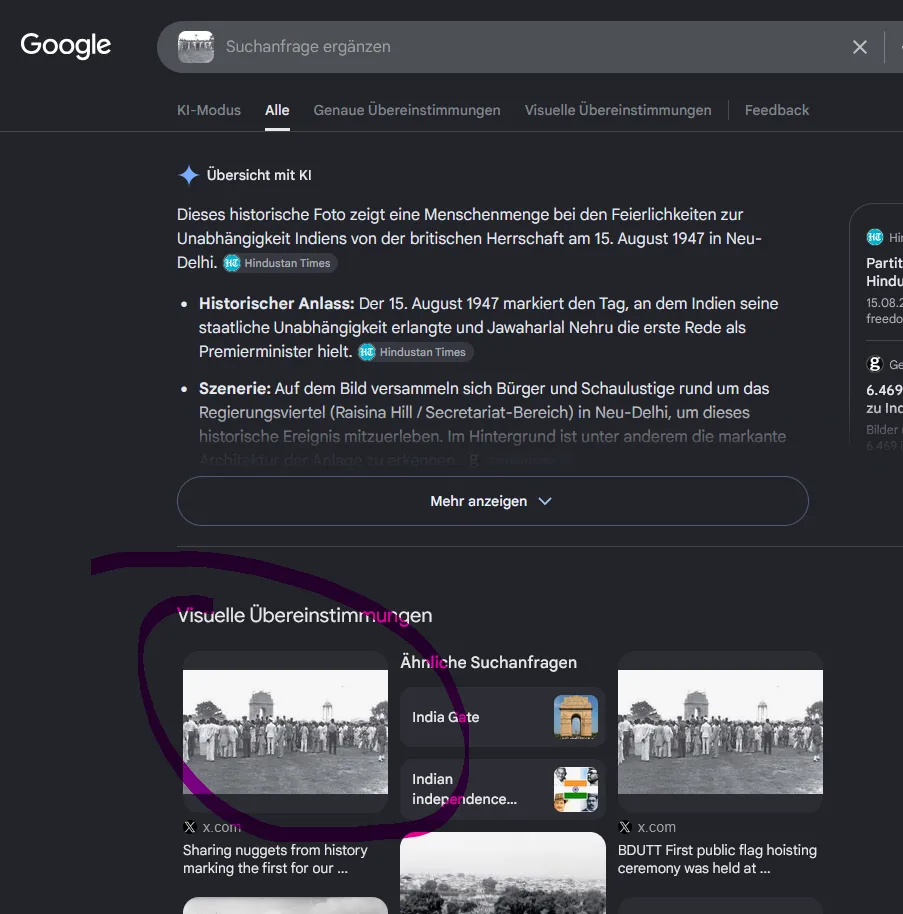
The reverse search that corrected the date — and planted the venue error in the same breath.
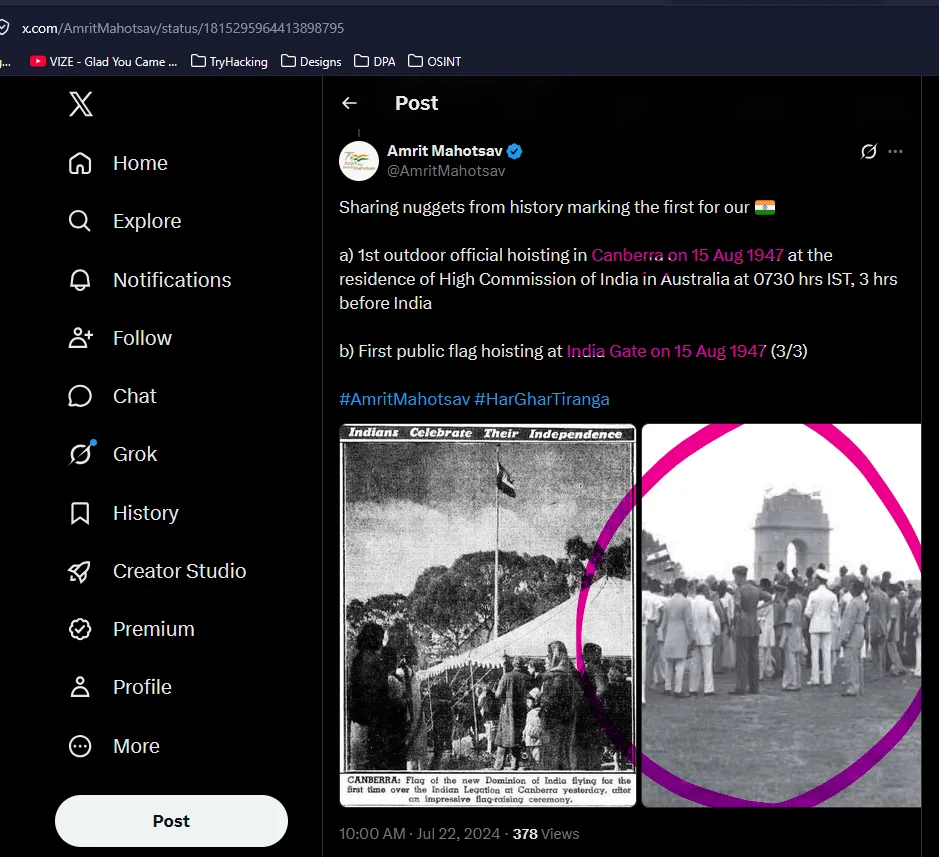
An official government account, a confident caption, a named landmark. Every part of it invites trust — and the venue is still wrong.
So I submitted:
trace{India_Gate_1947-08-15}Wrong.
The date was right. The place was not — and the caption was the problem.
The documented ceremony did not take place at the arch. The Indian national flag was first hoisted publicly at around 6 p.m. on 15 August 1947 on the open lawns of Princes Park, adjacent to India Gate. Multiple independent sources agree on this; India Gate appears in coverage only as the nearby landmark that readers recognise.
Lesson: when a caption gives you a location, ask whether it names the precise venue or the landmark next door. Journalism and social media routinely substitute the recognisable monument for the actual site, because the monument is what readers can picture. For a flag that wants a place name, that substitution is the difference between right and wrong.
This is the same failure mode as Error 1, one level up: I accepted a source’s framing without asking what it was actually asserting.
The spelling
Which left one question — how to render the park.
- Historically correct: Princes Park (from Prince, plural possessive without the extra s).
- As commonly published: Princess Park — the form used in much of the Indian press coverage of the 1947 ceremony, including Business Standard and the Flag Foundation of India.
The accepted answer was the newspaper spelling:
trace{Princess_Park_1947-08-15}This is the pattern that ran through the entire Trace board — Aiwan-e-Sadr over Aiwan-i-Sadr, Markaz Subhan Allah over the long form, Korda over the birth name. Setters build ground truth from the sources they can reach, and for a historical event that source is contemporary or popular press, not archival scholarship.
The practical rule: the correct spelling is the one your setter most plausibly copied, not the one a historian would defend. When two forms compete, prefer the one that dominates in ordinary search results, and keep the scholarly form as your second submission.
Flag
trace{Princess_Park_1947-08-15}Takeaways
- Don’t infer from blown-out regions. Overexposure erases pale objects. A negative conclusion drawn from a clipped highlight can exclude the right answer entirely.
- False exclusions are more expensive than false positives. A wrong guess costs an attempt. A wrong elimination costs the branch.
- Purpose-props date a photograph; architecture only places it. Flags, banners, and platforms are the event. Prioritise them.
- Captions name landmarks, not venues. Always ask whether a stated location is the actual site or the recognisable thing beside it.
- Ground truth follows the accessible source. For a historical place name, the popular spelling usually beats the correct one.
Sources
- X, @AmritMahotsav, 22 Jul 2024 — the official government post republishing the photograph, captioned “First public flag hoisting at India Gate on 15 Aug 1947”; the caption trap
- Salute Magazine — firsthand account by the ceremony’s deputy parade commander: flag hoisted at 6 p.m., 15 August 1947, Princes Park near India Gate
- Business Standard, 14 Aug 2023 — “it wasn’t the Red Fort”: Nehru’s first public hoisting at Princess Park near India Gate; the press spelling
- Flag Foundation of India, Know Your National Flag (PDF) — the foundation’s own book, p. 17: “first public flag hoisting ceremony was held at Princess Park, near India Gate” — the double-s spelling in print
- India TV News, 13 Aug 2022 — same venue, same “Princess Park” spelling; Red Fort only followed on 16 August
- Wikipedia: India Gate — the canopy’s George V statue, removed in late 1968; the basis for the false “empty canopy” dating
- Challenge: Athena Trace 2026 — “One Photograph”
Note the split within the sources themselves: Salute writes Princes Park, the others Princess Park. That disagreement is the spelling tension this writeup is about.
Image credits
Challenge artifact: archival photograph of the first public flag-hoisting ceremony, Princes Park, New Delhi, 15 August 1947. Reproduced in Indian government commemorative material; original photographer not credited. Search-result and X screenshots are the author’s own.