Spot the Location: Giraffes at the Eiffel Tower, Photographed in Zambia
Bellingcat Wild Lives. Two giraffes in front of the Eiffel Tower, standing in the Seine. Paris is a pasted-in backdrop; the coat pattern points to the Masai giraffe, and its range comes down to four countries. The last step is trial and error.
Title: Spot the Location (Bellingcat Challenge, Wild Lives series, by Foeke, Bellingcat)
Tagline: It’s a tall order! Giraffes… on holiday?
Description: Did you know the spots on a Giraffe are used to regulate their body heat? Giraffes can be found all throughout sub-Saharan Africa, but what about this species… At first ei-ffel for the edit, it drove me in-Seine
Question: In which country were the giraffes in this image most likely photographed?
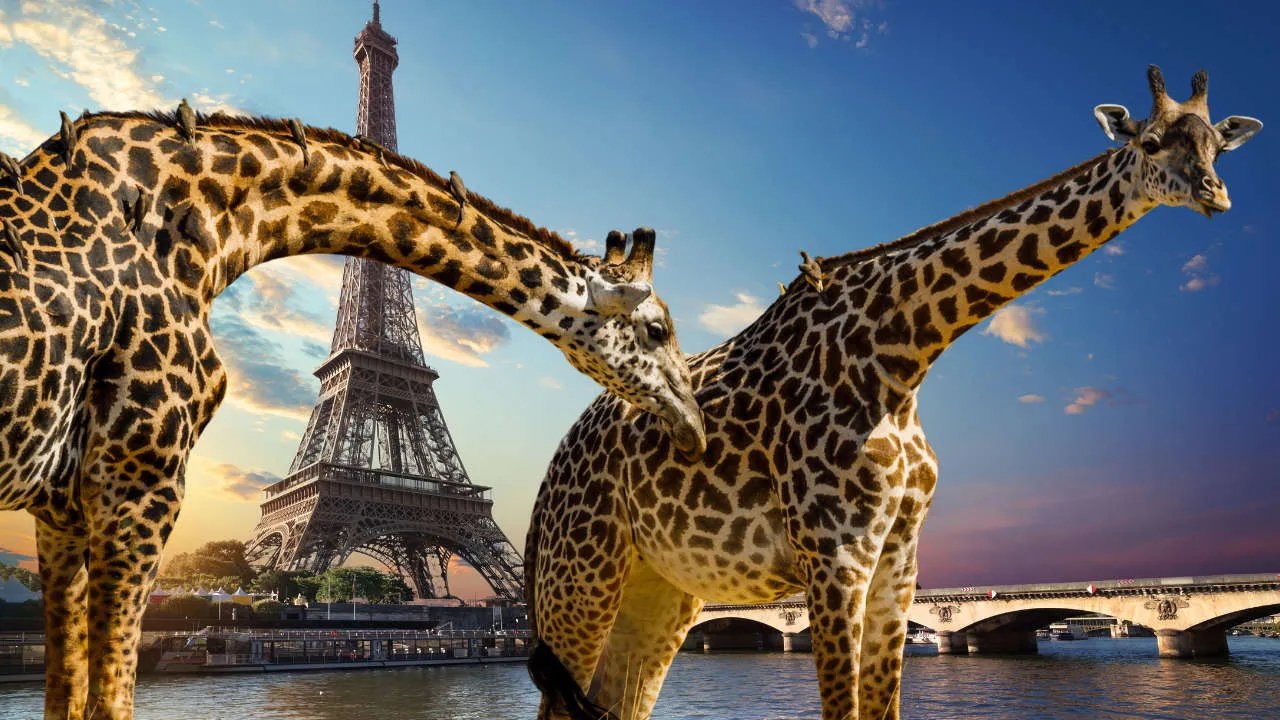
The challenge image, giraffe.jpg. Everything recognisable in it is Paris, and none of that is the answer.
The answer, up front: the background is Paris, but the giraffes were edited in. Their coat pattern, jagged dark blotches rather than clean polygons, belongs to the Masai giraffe (Giraffa tippelskirchi). Wikipedia lists its range as Kenya, Tanzania, Uganda and the Luangwa Valley of Zambia. The image can’t decide between those four, so the last step was trial and error: Zambia is the one the challenge accepts.
ZambiaWhat the image doesn’t give you: no EXIF worth reading, no text, no sign, and no ground under the giraffes. The question asks for a country, so the only usable evidence is the animal itself.
Step 1: False lead, Paris
Marked as a false lead so nobody skims it into the solution.
The backdrop is unmistakable: the Eiffel Tower, the Seine, and on the right the Pont d’Iéna, the bridge in front of the tower with the imperial eagles on its piers. Answering “France” would be locating the photo of Paris, not the photo of the giraffes, and the question is about the giraffes.
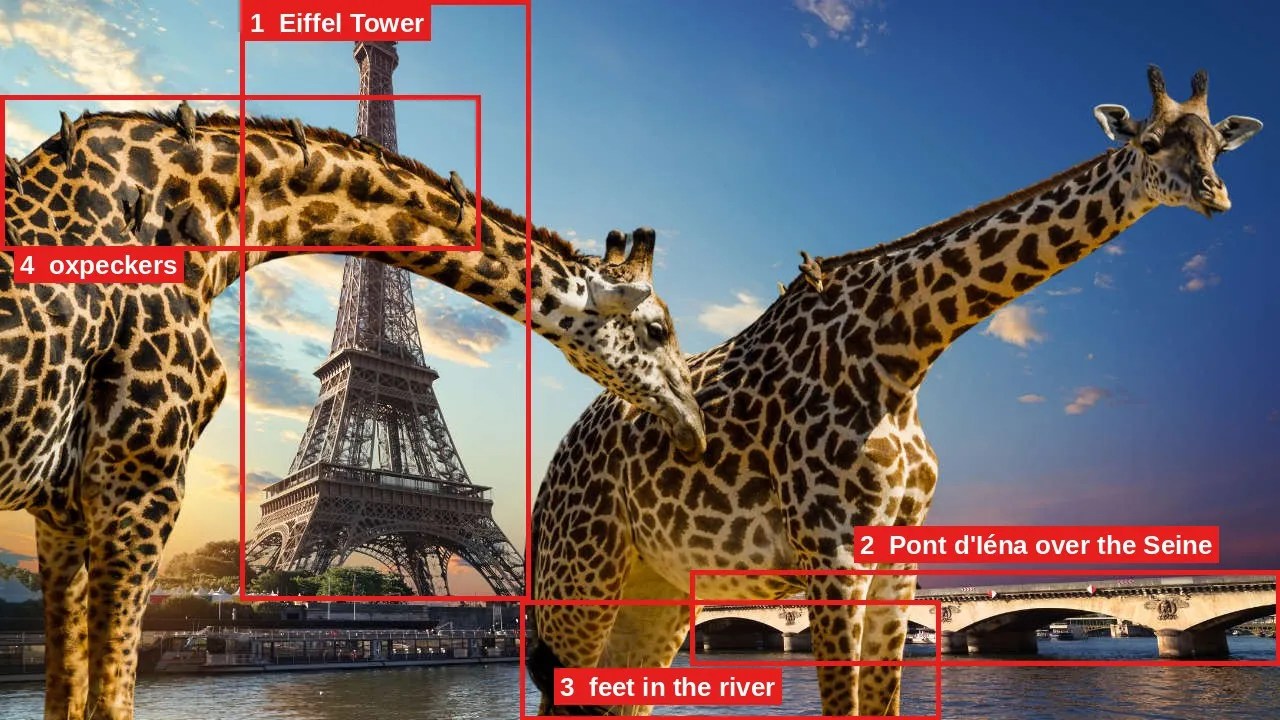
The right giraffe stands where the river is. Animals standing in a river are a montage, and the brief says so: “ei-ffel for the edit”.
Three things show it’s a composite:
- The ground doesn’t exist. The right giraffe’s legs end in the Seine (box 3).
- The scale doesn’t work. The giraffes are photographed from close below, the city from across the river; there is no ground plane that joins them.
- The brief admits it. “At first ei-ffel for the edit, it drove me in-Seine” puns on Eiffel and Seine and uses the word edit.
What the dead end teaches: in a composite, the question tells you which layer to locate. Here it’s the giraffes, so everything behind them is noise.
Step 2: The coat pattern narrows the species
Observation. Both giraffes have dark brown blotches with ragged, notched edges, set on a tan background. The blotches are irregular in size and don’t tile into neat polygons. The pattern runs down the legs.
Inference. Giraffe coat patterns are the field mark for telling species and subspecies apart. A Google search for
giraffe species coat patternleads to Conservation Mag: The different giraffe in Africa, which has a chart of nine patterns side by side:
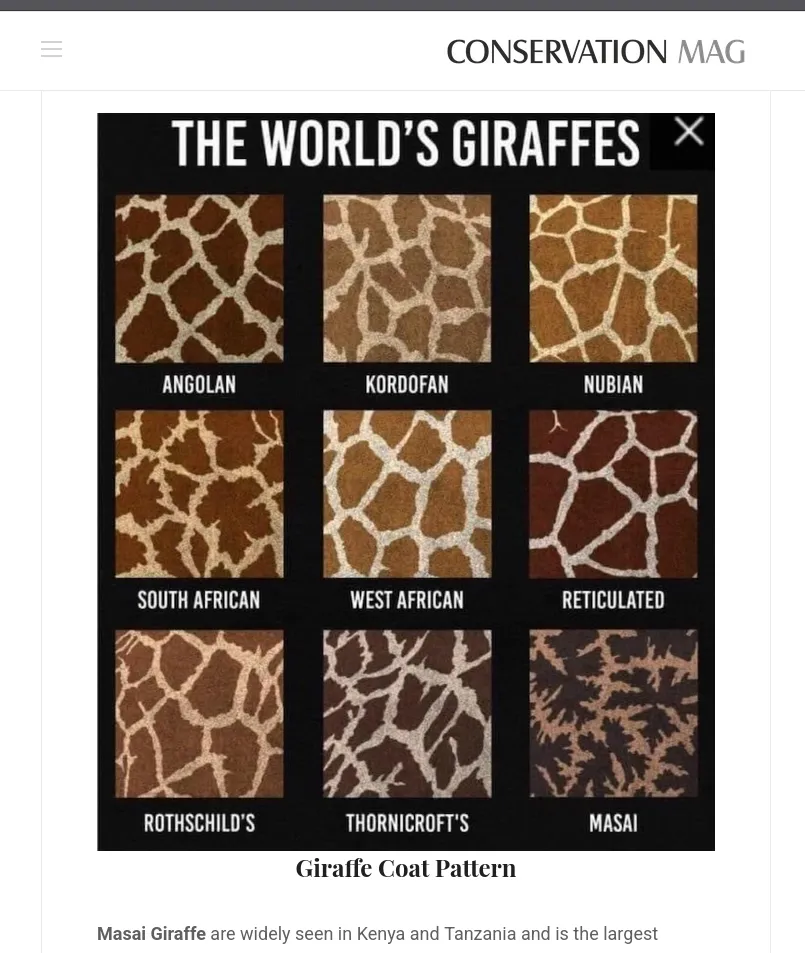
Seven of the nine have smooth-edged patches separated by straight light lines. Only Thornicroft’s and Masai have jagged, branching blotches.
Cropped and put next to each other:
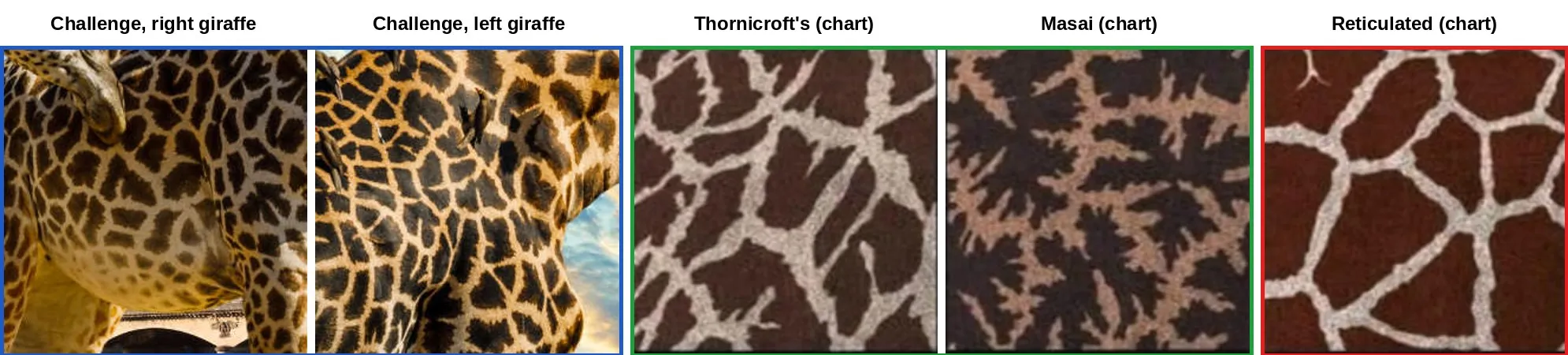
Blue: the challenge. Green: the jagged pattern family it belongs to. Red: what a clean-polygon coat looks like for contrast, the most common giraffe in photos and the wrong one here.
Then against a photo, not a chart swatch. The same article shows a Masai giraffe in the wild:
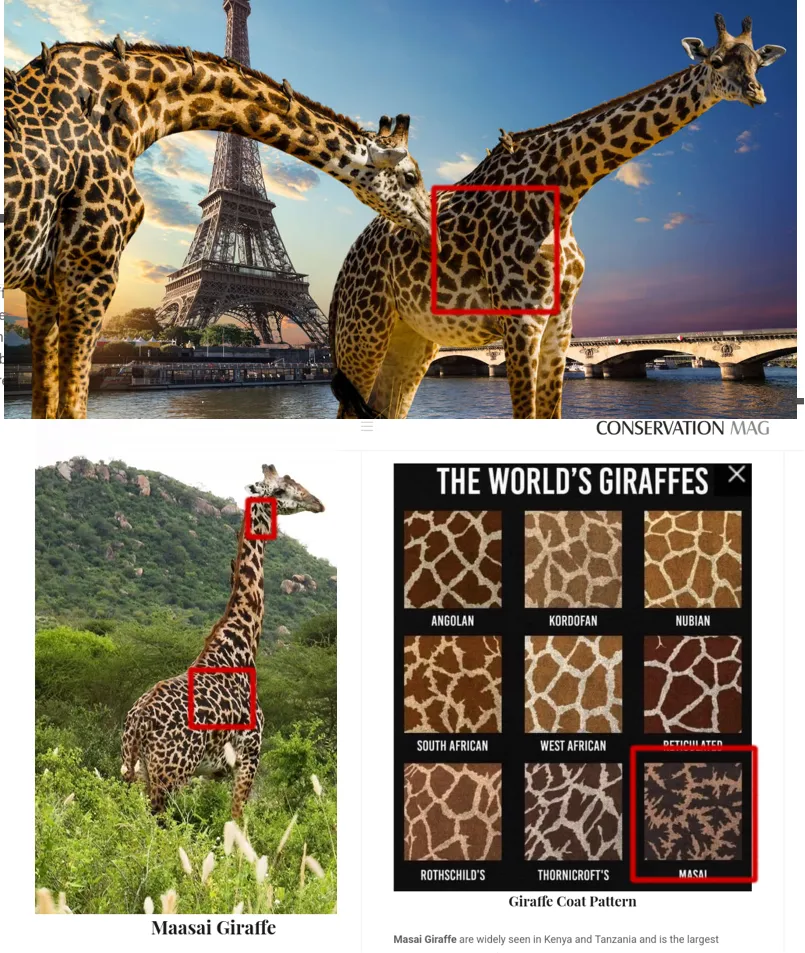
Same notched, leaf-like blotches, same tan gaps between them, same pattern down the neck. The match is the Masai giraffe.
How sure? Sure about the family, not the subspecies. Reticulated, Rothschild’s and the southern types are ruled out by the patch edges. Between Masai and Thornicroft’s, the chart swatches differ mainly in contrast, and a colour-graded stock photo against a sunset can’t carry that difference reliably. Both answers point the same way in the next step anyway.
Step 3: From species to country
Action. The Wikipedia article on the Masai giraffe, first paragraph:
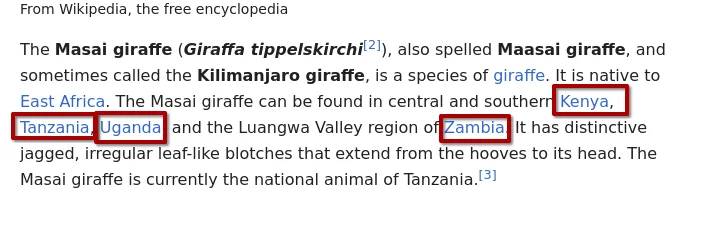
Four countries. The same sentence describes the pattern from step 2: “jagged, irregular leaf-like blotches”.
So the hint “Giraffes can be found all throughout sub-Saharan Africa, but what about this species…” resolves to a short list: Kenya, Tanzania, Uganda, Zambia.
The Zambian population is the odd one out. It lives only in the Luangwa Valley, cut off from the East African range, and it has its own name: Thornicroft’s giraffe, about 550 animals, “occurring only in Zambia’s South Luangwa Valley” (Wikipedia). Conservation Mag adds that it was long thought to be a separate, vulnerable population until genetic data showed it close to the Masai giraffe:
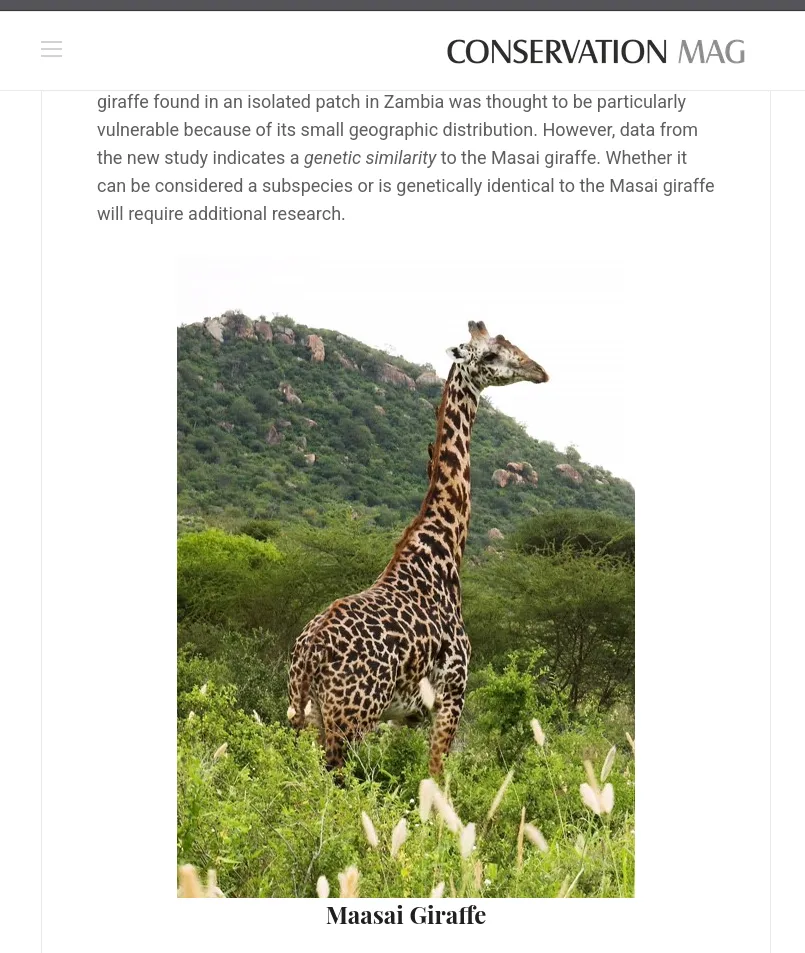
The link that ties the pattern to Zambia: the isolated Luangwa giraffes are Masai giraffes, and the chart’s Thornicroft’s swatch shows the same jagged family.
The last step is trial and error, and that’s fine here. Nothing in the image separates the four countries: no habitat, no ground, no vegetation, only the animals. Four candidates is a short enough list to try. Kenya, Tanzania and Uganda were rejected, Zambia was accepted.
In hindsight the brief fits Zambia best: it contrasts giraffes found “all throughout sub-Saharan Africa” with this species, and the Luangwa population is the one with its own name, its own isolated range and a single country.
Verification
- Two independent sources for the range. Wikipedia’s Masai giraffe article lists Zambia’s Luangwa Valley; Wikipedia’s Thornicroft’s giraffe article and Conservation Mag both describe the isolated Zambian population and its genetic link to the Masai giraffe. Since the 2016 genetic work and the IUCN’s 2025 recognition of four giraffe species, Thornicroft’s is classified as Giraffa tippelskirchi thornicrofti, a subspecies of the Masai giraffe (Wikipedia).
- The pattern from both directions. Step 2 went from the image to the chart; Wikipedia’s text goes the other way and describes the same “jagged, irregular leaf-like blotches” without reference to any chart.
- The alternatives. France is excluded as the backdrop of a montage (step 1). Kenya, Tanzania and Uganda can’t be ruled out from the pixels, only by the challenge: they were tried and rejected. That’s the honest limit of this solve. The image proves the species; the country among the four came from the answer box.
The moment of certainty for the species is the swatch row: of nine coat patterns, only two have jagged edges, and both lead to the Masai giraffe. That cut the world down to four countries; the answer box did the rest.
Answer
ZambiaTakeaways
- In a composite, locate the layer the question asks about. A famous landmark in the background is the fastest answer and the wrong one. Read the question for its subject before reading the image for clues.
- Animals are evidence. Coat patterns, markings and subspecies ranges work like licence plates: the species narrows the continent, the subspecies narrows the country. Find a reference chart, then confirm against a photo of the real animal, not only the chart.
- Read the range text, not just the map. One sentence on Wikipedia carried both the identification (“jagged, irregular leaf-like blotches”) and the answer list.
- Shrink the list, then it’s fine to try. When the evidence runs out at a handful of candidates and the challenge allows retries, testing them is cheaper than inventing a reason. Say so in the writeup instead of dressing it up.
- Puns in a brief are hints. “Ei-ffel for the edit” and “in-Seine” told you the Paris layer was fake before any analysis.
Sources
- Bellingcat Challenge 26: Spot the Location
- Conservation Mag: The different giraffe in Africa — coat pattern chart, Zambian population
- Wikipedia: Masai giraffe — range and pattern description
- Wikipedia: Thornicroft’s giraffe — Luangwa Valley population